This aluminum vs steel trailer comparison was written by Prestige Power & Marine in Innisfil, Ontario. We sell aluminum trailers and ice huts, so we have a stake here. We have tried to give steel a fair hearing anyway.
Choose aluminum if towing weight, corrosion and resale matter most. Choose steel if budget, hard impact and easy repair in the field matter most. That is the short answer. The rest of this article explains when each one wins, and where the sources disagree.
The short answer
Aluminum is lighter, so it carries more on the same rating. It does not rust. It costs more up front.
Steel is cheaper, tougher in a hard knock, and easy to weld in the field. It is heavier and needs rust care.
Neither wins across the board.
Weight and payload: what steel vs aluminum trailer weight actually means
Payload is the trailer's gross rating minus its own empty weight. At the same rating, the lighter trailer carries more.
Take a matched pair of 7×16 enclosed trailers, both rated at 7,000 lb. The aluminum one weighs 1,800 lb empty and carries 5,200 lb. The steel one weighs 2,490 lb and carries 4,510 lb. That is 690 lb more cargo, about 15 percent, from the material alone.
The gap changes with the build. One dealer puts steel at 16 to 30 percent heavier. A trailer maker claims 40 to 70 percent. On the matched 7×16 models we checked, steel ran about 19 to 43 percent heavier.
Two warnings. Some "aluminum" enclosed trailers are steel frames with aluminum skin, so read the placard curb weight. And in Ontario, a trailer with a gross weight of 1,360 kg (2,998 lb) or more needs brakes.
Ontario winters: salt, brine and what corrodes first
Ontario trailers get salted, repeatedly, all season. Chloride is the problem.
Painted steel has one defence: the paint. Chip it and rust starts, then spreads under the paint. Galvanized steel is better. The zinc protects the metal even when scratched, and it reaches inside tubes and seams. Its weak spots are welds, cuts and drilled holes. Welding burns off roughly an inch of zinc, and those spots rust first unless someone treats them with cold galvanizing compound.
Aluminum builds a thin oxide film on its own. It re-forms after a scratch. Salt can still pit aluminum, but over long periods that is mostly cosmetic.
Dealers like to quote years until rust. We found no published Canadian test data by coating, so we will not print a number.
The running gear on every trailer is steel. Axles, springs, brakes and fasteners rust on an aluminum trailer too. There, the first failures usually show up at steel fasteners and joints. The aluminum tends to go last.
Strength, stiffness and repair
Steel is not simply stronger. The usual trailer alloy, 6061-T6, has a typical yield strength around 40,000 psi. Mild structural steel (A36) has a minimum of 36,000 psi. Aluminum gets there at about a third of the weight.
The real gap is stiffness. The same shape in aluminum bends about three times as much, so builders use deeper sections and ribs.
Fatigue is the other difference. Steel has a stress level below which it can flex almost forever. Aluminum does not, so its life under repeated loading is finite, and cracks tend to start at weld edges. Welding also weakens the metal beside the weld, from roughly 45,000 psi tensile to 27,000 to 32,000 psi.
Repair is where they split. Steel dents and bends, and it is often straightened or welded on the spot. Aluminum tends to dent, then crack near the weld, and the piece is usually cut out and replaced. It needs TIG or spool-gun welding, and many general shops will not take it on.
Cost, resale and the payback question
Manufacturer figures put the aluminum premium at 20 to 40 percent at comparable ratings. One maker's worked example is $9,000 for steel against $12,000 for aluminum. That is their example, not an Ontario price survey. Get a local quote.
The same maker claims that after seven years, aluminum keeps 55 to 70 percent of its price and steel keeps 30 to 40 percent. No auction data backs that up, and we found no audited Canadian resale figures by material.
Here is the arithmetic, using the middle of those ranges. Steel at 35 percent retained loses $5,850. Aluminum at 62 percent retained loses $4,560. Aluminum comes out $1,290 ahead, despite the $3,000 higher price.
Change one assumption and it flips. If aluminum keeps only 50 percent, it loses $6,000, and steel is slightly ahead. The payback depends on resale, and nobody can prove that number.
Insurance does not decide it, as far as we found. We saw no rating class by material. A pricier trailer costs more to insure because it is worth more.
Maintenance over ten years
Painted steel asks the most. Wash the underside after salt. Touch up chips right away. Keep frame drain holes clear, or the tube rusts from the inside. One marine coatings source suggests repainting affected areas every two to three years in salt service.
Galvanized steel needs less. Rinse it, and cold-galvanize any weld, cut or hole made after the dip.
Aluminum needs a rinse after salt and no paint. Inspect the fasteners, because that is where it actually corrodes. Galvanic corrosion needs two metals and an electrolyte, and winter brine is a good one. Stainless screws in wet aluminum are the classic bad pairing. An insulating washer alone does not fix it, because the shank still touches the hole. Proper isolation uses a sleeve plus washers on both faces. Need hardware? See our trailer parts.
Then the treated-wood trap. Copper in ACQ-treated lumber attacks aluminum. The wood preservation industry calls for a quarter-inch gap or a polyethylene barrier of at least 10 mil. Lift the deck edge when you inspect a trailer. Bare aluminum against green-tinted plywood is a corrosion clock running.
Which one for an ice hut
On the ice, weight is paid for twice. You drag it out, and the ice carries it.
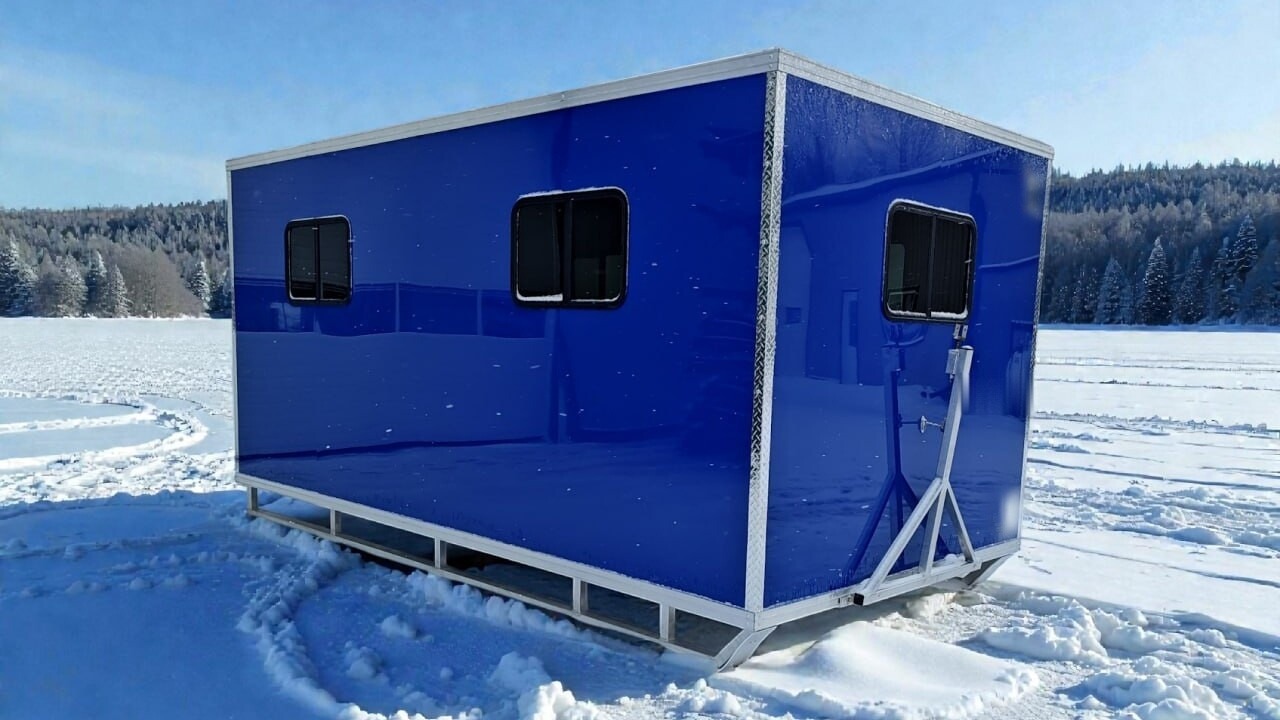
Published empty weights show the spread. Aluma-Lite aluminum skid houses run from 400 lb for a 5×7 to 1,450 lb for an 8×16. A 400 to 900 lb hut suits a snowmobile or ATV. At 1,450 to 1,800 lb you want a side-by-side or truck. Slush and drifted snow cut what a machine can pull well below its rating. Guidance on ice thickness for snowmobiles varies from 20 to 25 cm of clear blue ice. Use the bigger number.
Hard-side huts use aluminum frames for good reasons. No wood to rot or grow mould. Foam bonds straight to the frame. Lake water and slush do not rust it.
The catch is thermal bridging. Aluminum conducts heat roughly four times better than steel, so an exposed frame member inside is a cold strip where damp air condenses and drips. A good hut covers the frame in foam. Your heater matters more still. Unvented propane adds water to the air.
Not every hut is aluminum underneath. One 18-foot expandable at 4,000 lb uses a steel underframe with aluminum sheeting.
Aluminum vs steel trailer: the trade-off in one table
| Your situation | Better pick | Why |
|---|---|---|
| Budget is the limit | Steel | Costs less new |
| Towed often, kept ten years or more | Aluminum | No coating upkeep |
| Salted roads, no covered storage | Aluminum, or rinsed galvanized steel | No repaint cycle |
| Loaded close to the rating, or a small tow vehicle | Aluminum | More payload, less to pull |
| Rough jobsite, hard impact | Steel | Bends instead of cracking |
| Repairs far from a city | Steel | Any competent welder |
| Ice hut dragged on skis | Aluminum | No rot, light, foam-friendly |
Five things buyers get wrong
"Aluminum is always lighter." Per unit of volume, yes. But it needs deeper sections for stiffness, and some "aluminum" trailers are steel frames with aluminum skins.
"Aluminum does not rust, so it needs no care." The frame does not rust. Fasteners, axles and brakes do, and stainless in aluminum corrodes in brine.
"Steel is stronger, so it is safer." On paper, 6061-T6 yields slightly higher than mild steel. Steel gives you stiffness and bends before it breaks. Safety comes from joint design.
"Galvanized means rust-proof." The zinc is sacrificial. Welds, cuts and holes made after dipping are bare steel until someone treats them.
"A heavier trailer is built better." Weight is often just thicker gauge or a different deck.
So which should you buy?
Buy aluminum if you tow with an SUV or half-ton and load near the limit, keep trailers a decade, park outside all winter, or want a better shot at resale. Buy it for an ice hut.
Buy steel if budget decides it, if the trailer will take a beating on jobsites, or if repairs will happen far from a shop that does aluminum. In Ontario, make it galvanized, and rinse it.
Close to the line? Tell us what you tow with and what you haul through our contact page. We will say which fits, even if the answer is steel.
Questions we get asked
How much heavier is a steel trailer than an aluminum one? It depends on the build. On a matched 7×16 pair, steel weighed 2,490 lb against 1,800 lb for aluminum, about 38 percent more. Other comparisons run from the mid-teens to over 40 percent.
Does an aluminum trailer rust? The aluminum does not rust. It can pit in salt, mostly on the surface. The steel parts on it, such as axles and fasteners, still rust, so rinse after salt season.
Is steel stronger than aluminum? Not in the way most people think. 6061-T6 has a slightly higher yield strength than mild steel at about a third of the weight. Steel is stiffer, handles fatigue better and is easier to repair.
Is aluminum worth the extra money? It can be. Manufacturers put the premium at 20 to 40 percent. Payback depends on resale, and the claimed resale figures are not independently verified. The extra payload and lack of frame rust are real either way.
What about an ice hut? Aluminum frames are the common choice because they do not rot or rust and they are light to drag. They need foam over the frame to limit condensation.
We sell EZ-Hauler and Mission aluminum enclosed trailers and Rocklyn aluminum ice huts, plus trailer and marine parts. Browse the trailers or the ice huts and compare the weights yourself.
Pickup is at our shop in Innisfil. Call 705-321-0685 and we will go through the numbers with you.
